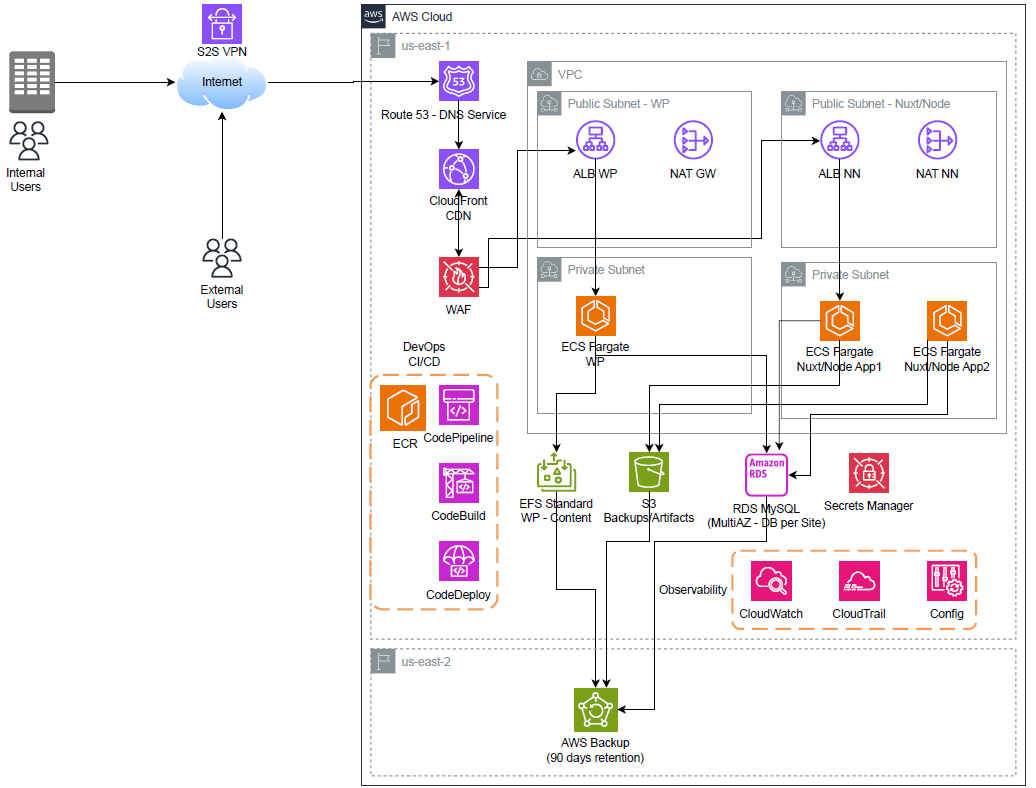
Overview
An enterprise organization operating multiple web properties needed a unified hosting platform that could support both WordPress and Nuxt/Node.js applications under multiple DNS configurations, with the scalability and reliability expected of a production enterprise environment. The solution had to eliminate manual deployment friction and ensure changes could be rolled out to containers automatically without disrupting live operations.
The Challenge
Enterprise web hosting at scale introduces complexity that shared hosting or simple VM deployments cannot handle: multiple application stacks, independent DNS management, container lifecycle management, and the need for a repeatable deployment process that doesn’t require downtime. The architecture had to be both developer-friendly and operations-ready.
Architecture
The solution follows a multi-tier model with strict network segmentation across three layers:
- Web Tier (10.0.0.0/24) — Public-facing layer handling incoming traffic, DNS routing, and load balancing
- Application Tier (10.0.1.0/24) — Containerized WordPress and Nuxt/Node.js workloads, isolated from direct internet exposure
- Database Tier (10.0.2.0/24) — Persistent data layer, accessible only from the application tier
The architecture is designed for high availability and redundancy, with each tier separated to allow independent scaling and maintenance without cascading impact.
CI/CD Pipeline
A complete CI/CD pipeline automates the full deployment lifecycle — from code commit to container update — without disrupting running services. Container changes are applied automatically using a rolling update strategy, ensuring zero downtime during deployments.
Multi-DNS Support
The platform supports multiple DNS configurations, enabling the organization to host distinct web properties under different domains from a single, centrally managed infrastructure.
Outcome
The platform delivers a production-grade hosting environment that scales with demand, supports multiple application stacks and domains, and removes manual deployment steps entirely. Operations teams can push changes confidently knowing the pipeline handles container updates safely and automatically.